





The Complete Guide to Yoga Mats: Use, Care, DIY & Buying Tips

What Is a Yoga Mat?
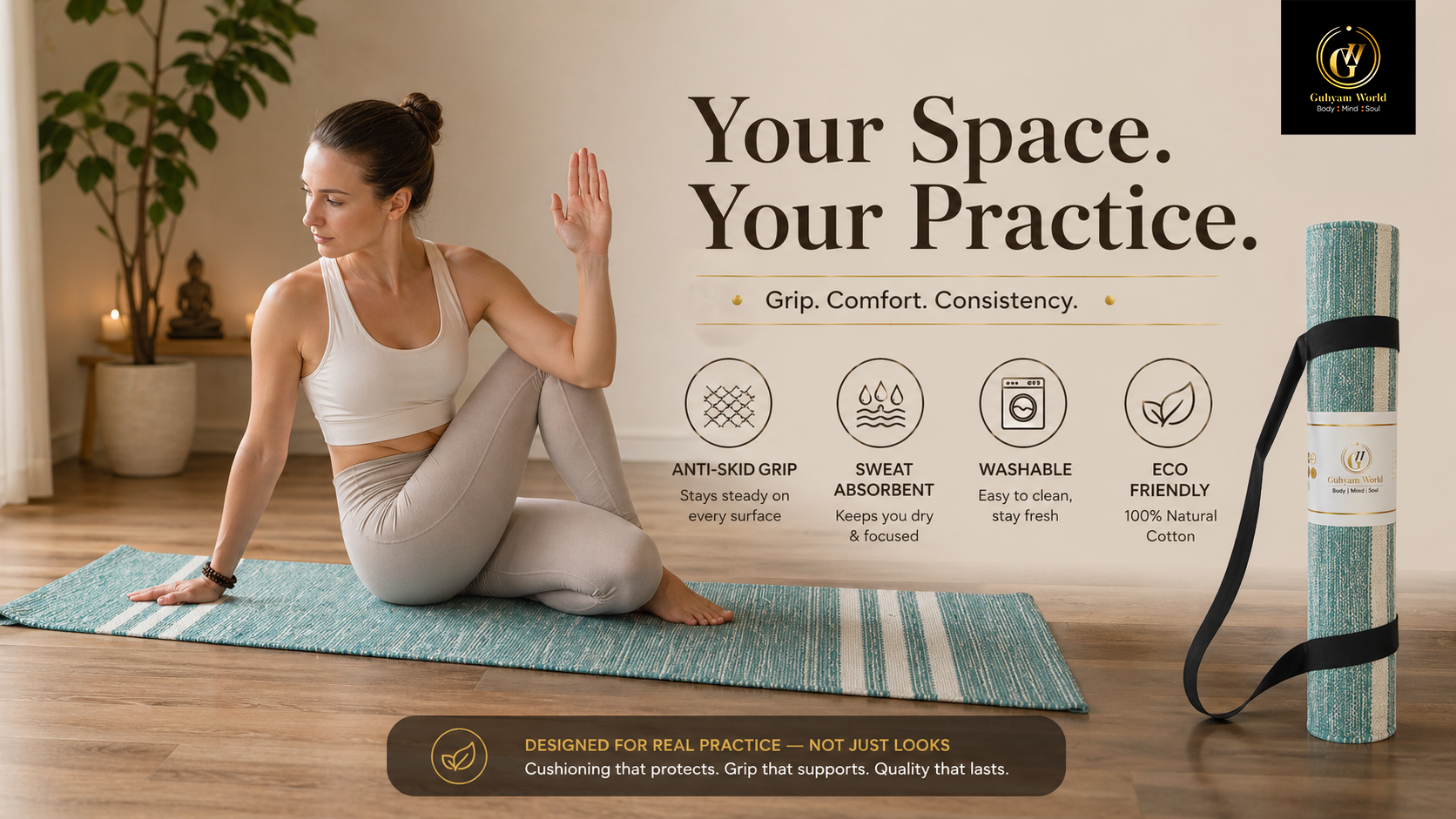
A yoga mat is a cushioned, non-slip surface made for yoga. It stops you from sliding, cushions your joints, and gives you a space that’s yours — bedroom corner, studio floor, doesn’t matter.
But there’s more going on than most product listings mention.
It does three things. It grips the floor — which matters more than people expect on the marble and tile floors most Indian homes have. It cushions your joints; research backs this up, showing that the right thickness reduces pressure on knees, wrists, and elbows and keeps your weight distributed evenly through poses. And it draws a line around your practice — a physical boundary that tells your brain this space means something.
Rolling out the same mat in the same spot trains your brain to associate that space with focused movement. For home practitioners especially, this is a quiet but real driver of consistency.
Know these three functions and you’ll evaluate mats completely differently.
How to Use a Yoga Mat?
Using a yoga mat is not complicated at all. But most people skip the why — and that’s where the small mistakes creep in.
- Lay it flat on a hard, even surface — carpet under a mat shifts and bunches, making the whole thing unstable
- Non-slip side faces the floor — the textured or rougher side goes down; flipping it cancels out the grip system entirely
- Practise barefoot — socks cut both tactile feedback and grip at the same time
- Clean your feet and hands before stepping on — body oil and dust are the most common reason mats feel slippery, even brand new ones
- Roll it back up — never fold — folding creates a permanent crease at the fold point; over time that crease cracks
One thing most guides miss: don’t step on the mat right after applying lotion or oil. Even mostly-absorbed products leave enough residue to affect grip for the first 15–20 minutes of a session.
Something that is easy to miss, a mat can look perfectly fine and still be quietly degrading. Sweat and skin oil don’t disappear — they settle into a thin residue that makes the surface more slippery each session and speeds up material wear. Regular cleaning is what keeps the mat performing.
Quick and Easy Clean (After Every Use)
· Mix a few drops of mild, fragrance-free liquid soap into water, avoid strong detergents, they break down surface coatings gradually
· Dampen with a soft cotton cloth or spray lightly
· Wipe the entire practice surface, not just where your hands and feet go
· Let it air dry fully before rolling up , rolling a damp mat is the quickest way to create mould and a smell that won’t leave
Deep Clean (Weekly)
· Mix lukewarm water with a small amount of gentle detergent in a tub or bucket
· Soak for 5 to 10 minutes
· Use a soft cloth to scrub abrasive sponges feel more thorough but actually scratch and wear down the grip texture
· Rinse until no soap remains in the water
· Hang or lay flat to dry away from sunlight , UV exposure breaks down rubber and PVC faster than most people realise
And one thing worth knowing before you start: don’t wring the mat out. It sounds efficient but it compresses the foam unevenly inside. Press gently to push the water out instead.
How Often Should You Clean a Yoga Mat?
| Practice Type | Clean How Often |
| Light practice (2–3x per week) | Wipe down 1–2 times per week |
| Daily or heavy practice | After every session |
| Deep clean | Every 1–2 weeks |
In India’s humid climate — especially through summer — lean toward cleaning more often. Humidity speeds up bacterial growth on mat surfaces, which hits both hygiene and grip faster than in drier conditions.
How to Clean a Cork Yoga Mat?
Cork mats need a different approach from synthetic ones. Most that fail early come down to one mistake: soaking.
• No soaking as Water weakens the bond between the cork layer and its rubber base. A barely damp cloth is all you need
• Mild and natural cleaners only. Chemical cleaners tend to dry out and crack cork over time. A few drops of mild soap in water fixes things, or a diluted tea tree oil solution if you want something antibacterial
• Air dries the cork mat away from sunlight as UV exposure discolours cork and makes it brittle faster .
Something worth knowing is cork by-nature is antimicrobial, so it fights bacteria better than synthetic mats . That does not mean skipping the clean — it means the clean itself is gentler and less frequent.
How to Remove Smell from a New Yoga Mat
The rubbery or chemical smell from new synthetic mats is off-gassing some volatile compounds escaping as the material settles after manufacture. It is common and fades with time. These methods speed that up:
- Leave it unrolled in a ventilated space for 24 to 72 hours , outdoors in shade works best; this is the single most effective step
- Sprinkle baking soda across the surface, leave for 30 to 60 minutes, wipe clean as it absorbs odour molecules rather than masking them
- Spray with equal ratio vinegar-water mix, wipe, air dry as the vinegar smell itself disappears within minutes
When the smell signals something more – PVC mats can release more VOCs when exposed to heat and sweat, which is a real consideration in Indian summers. If a strong chemical smell has not faded after a week of airing out, you should switch to a TPE or cork mat rather than continuing to use it daily. Usually persistent chemical odour from cheap mats are due to phthalates or foaming agents in the material.
How Much Is a Yoga Mat?
Here’s what you actually get at each price point in India, as of April 2025:
| Price Range | What You’re Getting | Realistic Lifespan |
| ₹300–₹800 | Basic EVA or PVC; grip fades within weeks of regular use | 2–5 months |
| ₹800–₹2,000 | TPE mats; decent grip, lighter, eco-friendlier | 1–2 years |
| ₹2,000–₹5,000+ | Natural rubber, premium TPE, cork; grip holds long-term | 3–7 years |
The real cost comparison: a ₹500 mat replaced every four months costs ₹1,500 a year — and most of that time you’re fighting degraded grip. A ₹1,500 TPE mat lasting two years costs ₹750 a year and performs well throughout. For beginners, a mid-range mat with decent grip and 4–6 mm thickness is the standing recommendation — it lasts long enough to support learning proper alignment.
On safety by price tier: budget mats under ₹800 are almost always PVC or EVA. PVC mats commonly contain phthalates — added to create flexibility — which are endocrine disruptors. If budget is tight, look for mats labelled “6P-free” or “phthalate-free,” or choose TPE. OEKO-TEX Standard 100 certification tests against around 100 chemical parameters including phthalates, BPA, AZO dyes, and lead — it’s the most accessible safety verification you’ll find in the Indian market. Look for it on any mat you plan to use daily.
How to Carry a Yoga Mat on a Backpack
- Use the built-in straps or loops on your backpack – most gym and trekking bags have attachment points along the sides or bottom panel
- Clip carabiners through the rolled mat’s strap loops, then attach to any D-ring or side loop on the bag
- Horizontal across the bottom works for short trips and vertical along one side is more secure for commutes
For Bangalore specifically: in auto-rickshaws and on BMTC buses, a vertically strapped mat is much easier to handle than a horizontal one, which catches on seat edges and doorways. A fitted carry sleeve is a small investment that pays off fast if you commute to a studio regularly.
How to Tie a Yoga Mat Strap
Most mid-range mats in India come with a basic strap included. Steps on how to use it properly:
- Roll the mat tightly from one end — uneven rolling creates a bulge in the middle that loosens the whole thing during carry
- Loop each strap end around both ends of the rolled mat — position about 6–8 inches from each end for balanced weight
- Pull firmly to tighten — the loops cinch automatically on adjustable straps; a properly tightened strap won’t slide
- Wear as a shoulder sling — set the length so the mat sits at mid-back, not swinging below the hip
No strap included? A standard luggage strap or a length of cotton webbing from any hardware shop in India (under ₹50) does the same job — and usually outlasts the strap the mat came with.
How to Sew a Yoga Mat (DIY)
A DIY mat has real limitations , grip and cushioning being the main two. Its worth knowing before you start. But if the goal is a natural-material surface for meditation, a temporary practice mat, or just a creative project, making one at home is something worth trying.
What You’ll Need:
· Thick cotton fabric or canvas in 2 layers , tightly woven works best, available at any fabric shop
· A non-slip rubber or latex base sheet , check hardware stores or order online
· Heavy-duty thread with a needle or sewing machine
· Foam padding if you would like some cushioning underneath
How to Make It:
1. Cut every layer to 68 × 24 inches (173 × 61 cm) , add four inches in length if you are on the taller side
2. Stack the layers in order: rubber base at the bottom, foam in the middle if you’re using it, cotton fabric on top
3. Pin all layers together before stitching , then sew the edges with at least a 1 cm seam, a double-stitch or zigzag pattern handles repeated rolling far better than a basic straight stitch
4. Go back over the corners with an extra pass, they are the first thing to come apart
5. If you want a carry strap, sew two small fabric loops at one short end
Now the honest bit, cotton put on tile or marble slides. This kind of mat works well for seated meditation, breathing practice, or placed over an existing mat for extra comfort. The moment you are doing standing poses, you want a manufactured mat under your feet , the grip difference is not just comfort, it’s about your safety.
Final Thoughts
A yoga mat is more than an accessory. It’s your personal space for movement, stillness, and focus.
The right one holds firm when you need it to, protects your joints session after session, and creates a physical cue that tells your brain it’s time to slow down. The wrong one creates friction — literally — that compounds over weeks into frustration and dropped sessions.
Whether you’re buying your first mat or looking after one you’ve had for a while: match the material to your budget and safety needs, clean it consistently, store it rolled in a dry spot, and use it on a hard flat floor.
None of it is complicated. But each step compounds. That’s what keeps you grounded — literally and practically.
FAQ
Are yoga mats toxic?
Some are. It comes down to what they are made of. PVC mats need phthalate plasticizers to get their flexibility, and EVA foam mats typically use formamide as a foaming agent.
Neither of them is something you want pressed against your skin daily. The safer choice are natural rubber, cork, and GOTS-certified organic cotton. If you are going for synthetic, you should consider OEKO-TEX Standard 100 certification , it checks against around 100 chemical parameters and is easy to find in India. “Eco-friendly” or “non-toxic” on a packaging without that kind of third-party backing is a marketing call, not a safety guarantee.
How many mm yoga mats are good?
For most people starting out, 5–6 mm hits the right balance ,enough to protect your joints, not so much that you’re balancing on something that moves under you. Research shows that once you go past 6 mm, proprioceptive feedback starts to drop. That’s your body’s ability to sense its own position in space and it matters more than people realise in poses where you’re on one leg or moving through transitions. If you’re dealing with a diagnosed knee or wrist condition, 6–8 mm may be worth trying , but that’s a conversation to have with a physiotherapist, not a decision to make based on thickness alone.
Is a yoga mat necessary for exercise?
Technically, no. But practising on bare marble or tile, which is most Indian homes , means real slip risk, harder joint impact, and a level of physical discomfort that quietly pulls attention away from the practice itself. If you are doing yoga three or more times a week, the mat isn’t really an accessory anymore. It is what makes the practice sustainable both physically and as a habit.
Which yoga mat to buy in India?
Price under ₹1,000 to above ₹2000: Check out Yoga Mats in Bangalore, India from Guhyam World TPE range. Check the listing explicitly says TPE — not just “eco foam. — honestly labelled, testable in-store, clear material and thickness specs. (India-made, phthalate-free, made by yoga teachers) and cork mats.
Where to buy a yoga mat in Bangalore?
In-store — best for first-time buyers:
Guhyam World in Bangalore, where you can stand on the mat and check the grip before buying. For a first purchase, that’s worth more than any online review. Their range runs from beginner-friendly entry mats to performance options, all clearly labelled by material and thickness.
For premium mats, where their mats can be tried, they ship with free returns on manufacturing defects.
You can also try their online store to buy yoga items and wellness products.
Online: Amazon India has the widest range. Filter explicitly by material (TPE, cork, or natural rubber). Read reviews from users who’ve had the mat for 6+ months. First impressions tell you almost nothing — grip degradation only shows up after sustained use.