





The Art of Mindfulness: Why Your Environment and Tools Matter for Your Wellness Journey

You’re Not Bad at Meditating. Your Space Just Hasn’t Caught Up Yet.
Let me guess.
You’ve tried. Maybe you downloaded the app, watched the YouTube tutorials, even bought a mat that’s been rolled up in the corner for three months. You sit down with genuine intention and — nothing. Your mind immediately starts thinking about the grocery lists and replaying that awkward thing you said at a meeting two years ago.
So you conclude you’re simply not cut out for this.
What nobody tells you when they hand you a breathing exercise manual it that mindfulness is not a skill you perform. It is a state your environment either supports or sabotages.
And in a city like Bangalore — where the traffic starts at 7am and doesn’t really stop, where your phone and your laptop and your deadlines are all competing for the same three square feet of mental real estate — most of our environments are optimised for everything except stillness.
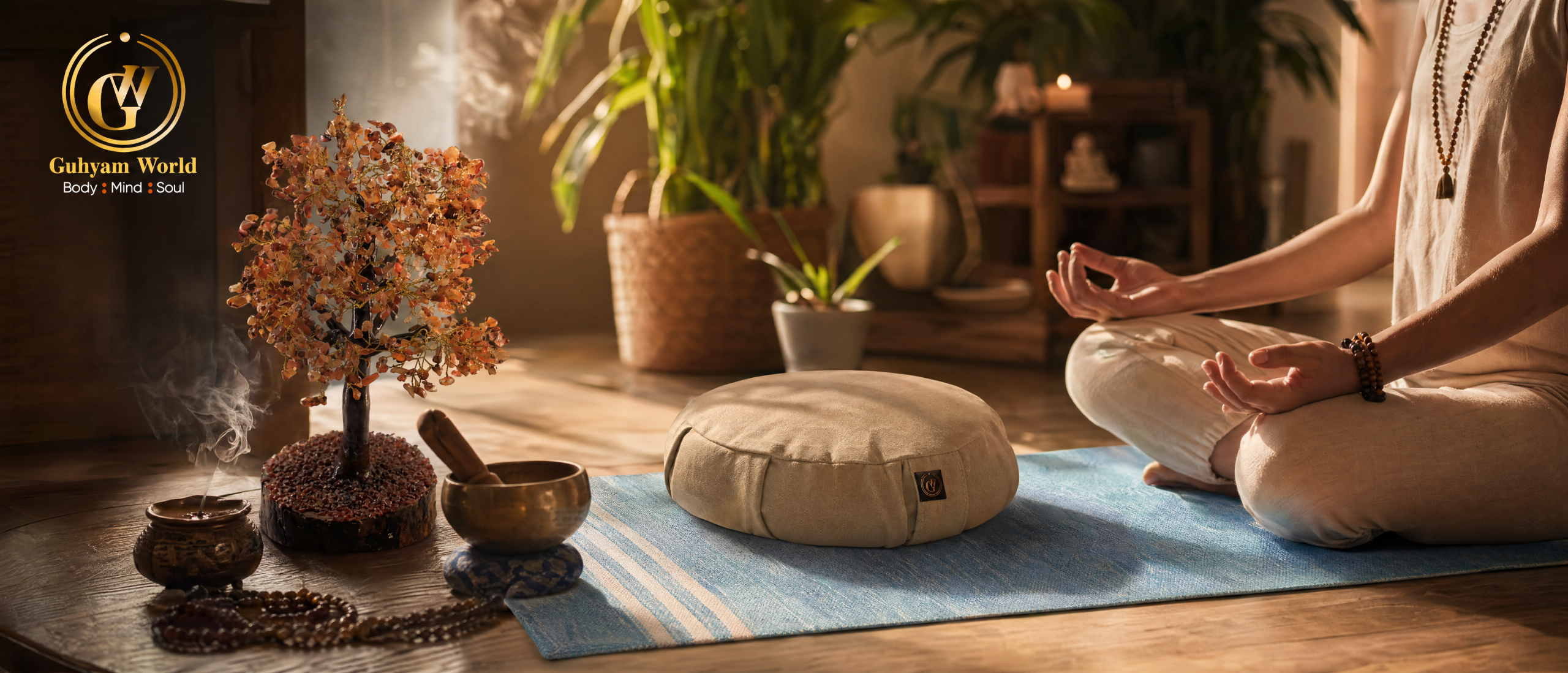
A few months back, one of our regular customers — a UX designer who works from home in Koramangala — told us she had been meditating “unsuccessfully” for two years. She’d tried every technique. Apps, teachers, silent retreats. Nothing stuck, then she made a change and cleared one corner of her bedroom, put down a proper cushion, kept a small brass bowl and a stick of incense there, and committed to sitting in that specific spot every morning. Just that corner! Just those objects! Nothing else changed!
Within three weeks, she noticed that her body started relaxing the moment she walked toward it.
That’s not a coincidence. That’s neuroscience. And it’s exactly the kind of shift we built Guhyam World to help you make.
What your brain is actually doing when you try to meditate
Your brain does not switch states like you switch tabs.
It needs the room to give it a signal first. A little cue that says: this is different from what happened before.
If you meditate on the same sofa where you scroll Instagram and take work calls, your nervous system gets mixed messages. The room still holds the residue of everything. So there is no real border between chaos mode and stillness mode. Your brain just keeps doing what it has been doing all day.
A small meditation corner in a one-BHK gives you that border. This is not decoration. It’s a way to teach your brain that this place means something else. Sleep doctors say the same thing when they tell people not to work in bed. Location shapes how you feel. Every time.
three senses that shape your state
sight: color as a mood regulator
Color changes alertness. Earthy tones like warm cream, soft terracotta, and deep green lower stimulation. The same reason why hospitals moved away from white walls. Color is still working, even if you aren’t watching it.
scent: the fastest path to the present moment
Smell goes right to the part of your brain that stores feeling and memory. Light the same incense every time and it becomes a cue before you even close your eyes
Touch: why texture matters
What you sit on and touch sends signals to your brain all the time. Synthetic, slick, or hard materials keep the body a little alert. Natural materials — soft cotton, unfinished wood, organic weave — feel closer to your body. That match is grounding. Grounding is what turns sitting with your thoughts into settling into them.
The objects in your space are not accidental. They are part of the practice.
Why the Quality of Your Tools Is Not a Vanity Decision
We want to say something honest here, because it often gets obscured by either luxury branding or false minimalism.
There is a real, tactile, felt difference between tools made with care and tools made for a price point.
We learned this the uncomfortable way. In the early days of Guhyam World, we sourced a batch of carry bags that looked right — the aesthetic was clean, the price was accessible. But within weeks of using them ourselves, something felt off. The zipper caught. The fabric had a faint synthetic smell that lingered. Small things, you’d think. But in the context of a practice that is entirely about sensory attunement, small things are everything.
We scrapped the batch. Started over with a supplier who worked with natural, breathable materials and finished seams by hand. The difference — in feel, in smell, in how the bag sat in your hands — was immediate. And when customers told us their bag had become part of their ritual, that they felt something shift just picking it up before a session, we understood what we’d nearly traded away for convenience.
Why Natural Materials Change the Quality of Practice
Synthetic materials are not neutral. They hold static, they don’t breathe, and there’s an intangible quality to them that keeps the body slightly on the surface of things — slightly away from the depth a good session requires.
Natural materials like organic cotton, hand-finished textiles, unprocessed fibres feels like they belong to the same world your body does. That alignment might sound abstract, but practitioners notice it. Especially once they’ve experienced the contrast.
At Guhyam World, sustainability isn’t a positioning statement. It’s a design requirement, because it directly affects how your tools feel — and how your tools feel directly affects how your practice goes.
Your Meditation Tools Should Age With You
Wellness culture has quietly inherited fashion culture’s worst habit: seasonal replacement.
But practitioners with the deepest, most stable practices we have met are not the ones with the newest gear. They are the ones whose mat has been rolled and unrolled a thousand times repeatedly. Whose carry bag has been to retreats and parks and early mornings on rooftops. Whose cushion has the particular give of something that has genuinely been sat on, consistently, for years.
There’s something in that continuity that supports practice in a way nothing new can. The object carries a history. It becomes part of the ritual identity. When we make our products to last, we’re not just reducing waste — we’re giving you the chance to build something real with them.
Three Ways to Actually Start — Starting Today
No overhaul required. No new schedule. No dramatic life pivot.
1. Five Minutes Before Your Phone Touches Your Hand
This is the one non-negotiable we’d give anyone.
Before you check anything — before news, messages, the weather, the time — sit for five minutes. Same spot. Same time. Just breathe.
Not because five minutes will transform your nervous system on day one. But because those five minutes, stacked daily for thirty days, rewrite your morning’s opening chapter. Your brain begins to expect stillness first. It stops reaching for stimulation as its default opening move.
Consistency trains your nervous system better than random bursts of intensity. Five steady minutes beats forty scattered ones.
2. Pick One Object and Make It Sacred Through Use
Choose something physical – a cushion, a small brass bowl, a specific incense. Use it only for practice. Never while watching something, never while working, never casually.
Exclusivity is what gives it power. Your brain identifies patterns, and when one object appears exclusively in the context of stillness, it becomes a reliable trigger for that state. The object doesn’t hold the calm , you do. But the object learns to reliably bring it forward.
Our customers often tell us this is the shift that made everything click. Not a new technique. Just a physical anchor that their brain had learned to trust.
3. Carry Your Practice With You – Because Life Doesn’t Stop for Mindfulness
This is where most wellness routines quietly collapse.
Your morning corner is wonderful. But you also exist at 2pm on a Wednesday when a meeting goes sideways. You exist on a crowded metro. On a work trip. At a family gathering that is going exactly as expected.
If your tools stay home, your practice stays home. A well-made carry bag is not a lifestyle accessory. It is what makes your practice portable and portability is what makes it durable. When your mat, your cushion, your incense travel with you, the ritual travels with you, Consistency doesn’t break when life moves.
The Word “Guhyam” – and Why It Named This Whole Thing
Guhyam (गुह्यम्) is Sanskrit. It translates as hidden — the subtle, interior knowledge that doesn’t announce itself.
Come Find Out What the Difference Feels Like
✦ Visit Our Store in Malleshpalya, Bangalore
While you can read about natural materials and intentional design for a long time, Instead as a better option you can walk in, hold something, breathe in the space, and know immediately whether it’s right for your practice. Our store in Malleshpalya is built to be moved through slowly. No pressure, no pitch. Just come and feel the difference.
📍Guhyam World — Malleshpalya, Bangalore
✦ Follow Us on Instagram & Facebook
For daily grounding — real routines, honest reflections on practice, and behind-the-scenes on how we make what we make — find us on Instagram. It’s a quieter corner of that platform than most, and we’d like to keep it that way.
Your environment is not the backdrop to your practice. For most people, it is the practice. Change the space, and the sitting changes with it.